Is it just me or is Wednesday the absolute worst day of the week?
Seriously.
I mean, Monday is a complete write off. You know what you’re getting into when you wake up on a Monday – just getting through the day feels like some awe-inspiring accomplishment. Tuesday is great because, well, it’s not Monday. Thursday is fab because it is the lead-in to Friday, and hell, Friday is the awesome appetizer to a wonderful and exciting entree called “The Weekend.”
But Wednesday? Blah. It’s uninspired. It spreads itself so thin it’s practically a recommended serving size of peanut butter. Even a Wednesday full of meetings doesn’t make the time go by. Instead, the day still drags, and at the same time still gives me anxiety about all the stuff I have yet to get done.
Overall, a pretty bleak experience. So, in order to combat the evil Wednesday, I have developed certain coping mechanisms to get me through the day: going for an hour long walk at lunch time if the weather is nice; trying on all the beautifulbut painfully expensive clothing at BCBG if the weather is crap; eating all the leftover baby shower cake; etc.
The most important step though, to surviving a Wednesday, is the way I start my morning. In the ten minutes I have between getting off of the skytrain and turning my computer on in my office, I stop by the Second Cup coffee shop underneath Bentall 4, make small talk with the lovely baristas who work there, and order a small, non-fat, vanilla bean latte.
These drinks are lifesavers – I never used to drink coffee before I started my new job, but now that I am Ms. Tired McTiredmeister all the live-long day, I rely on this magical combination of espresso, steamed milk and vanilla extract to wake me the heck up in the a.m.
This morning I was flipping through the The Province (investigative journalism at its finest), waiting for my drink, when I came across a story about a young skunk named “Bubbles” who had recently undergone surgery at the Burnaby Wildlife Rescue Association because she had become ensnared in a bubble tea lid.
Well folks, reading this story, on a Wednesday, without having ingested my daily nectar-of-the-gods NEARLY DID ME IN.
I was enraged.
That poor baby skunk. How scary that must have been for her. How utterly helpless she must have felt to be trapped in something so foreign, so toxic and so destructive.
Seriously, I cannot stand people who don’t properly dispose of their crap. I mean, how hard is it to carry that drink cup for what, five more minutes until you come across the correct receptacle for disposal? YOU ARE KILLING BABY SKUNKS YOU HUMAN PARAQUAT.
People are so bloody spoiled, ignorant and complacent about these things. And hearing about the plight of young Bubbles only destroys me even more. I have so much respect and admiration for the people working for organizations such as Wildlife Rescue because I don’t think I could ever handle a job like that. I think my heart would break over and over again and that I would either 1) go completely mad and turn into an incensed, insane wildlife protection vigilante or 2) run away to become a hermit who lived in the wilds of the Yukon before being eaten by my pet bears (and inevitably have a film made about my life narrated by Werner Herzog.)
When I was living in England two years ago, I was walking home from campus one night and the fellow in front of me stuffed his Subway garbage in one of the university’s hedges. I grabbed the plastic bag out of the hedge and sped up my gait, hoping to catch up with him and publicly shame him. He happened to see me retrieve the garbage, and noticing my enraged approach, quickly took of up the hill at what was pretty much a run. Not to be outdone, I took off too, matching his pace. When we reached the top, he paused for breath and I yelled out, “YOU CANNOT JUST STUFF YOUR GARBAGE IN A BUSH!”
Shocked that I had actually ended up saying something, he looked over at me and muttered with derision, “Bloody American.” The he took off again.
I was so shocked that he would try to use my (perceived) nationality as a comeback, all I could think of for a reply was, “I AM CANADIAN!!!”
To anyone who witnessed this, I must have looked quite a sight – just blithely yelling out my nationality to an empty street, what with the hedge garbager having escaped into the night.
So let this serve as a warning: while I may not be at option 1 (see above) status yet, I have no problem outing those who don’t treat Mother Nature, and her lovely animal friends with respect. TRUST.
…
On a more positive note, here are some of the lovely animal friends my husband and I met whilst in the U.K.:
This is Saffi, a rescue dog with a big smile and a bushy tail. M and I met her whilst walking along one of the canals that connect Warwick with Leamington Spa. The canal network throughout England is really something to behold. You can walk all the way from Birmingham to London along these waterways.
This is the swan that stepped on M’s foot while nipping at his fingers because the bread wasn’t coming fast or furious enough. Kensington Gardens was beautiful that day. Its vast, but inviting green space was speckled by frost and snow; whispers of tourists blown to its far corners, drinking hot chocolate to stave off the cold. M and I fed the swan until our sandwiches were gone; as hard as he tried, the taste of our fingers were just not to our web-footed friend’s liking.
These are three of the sheep friends I made on a day trip out to Baddesly Clinton, a medieval manor house in Warwickshire. When I think about this day, all I can think about is how vibrantly beautiful it was. I felt as though I was living inside of a prism.
So a couple of weeks ago I wrote about an ad in the women’s change room of my gym – an ad that was giving me so much grief that every so often I felt as though I was going to have a panic attack on the treadmill.
A few days after I published that post, I finally reached my breaking point – the time for action was nigh.
In the parlance of our times: it was do or die.
I’m proud to say that instead of taking a sharpie and writing “HEY GROSSO! YOUR STRETCHMARKS MAKE YOU SUBHUMAN, SO GIVE UP AND JUST EAT THAT BURGER WE ALL KNOW YOU SO DESPERATELY WANT!” in an attempt to force them to take down the ad (due to my subversive measures) I decided to take the high road and speak with the young lady who works at the front desk.
In all honesty, I was actually pretty nervous as I approached the counter-cum-smoothie bar. I knew that I wasn’t being unreasonable bringing up the ad, but I couldn’t quite shake the feeling that I was going to come off as unreasonable.
However the thing that I am most ashamed to admit, is that more than anything, I was afraid. I was afraid that she was going to judge me as an overly sensitive and insecure about my body.
I was afraid that she would tell me that the ads themselves weren’t the problem – I was.
Which definitely made me pause and question whether or not these fears had any merit – not in so far as I actually believed that this young lady would resent me, or formulate conclusions on my self-esteems based on a two-minute interaction, but rather if this fear of a perceived lack of confidence existed outside of this made-up scenario.
Simply put: did these ads make me insecure about my body? Or do I feel insecure about my body whether or not these ads exist?
I don’t have a simple, clear-cut answer. It’s something that I’ve given a great deal of thought to, and will continue to do so over the next little while.
I can tell you that my conversation with the girl at the front desk was short and extremely positive. She seemed surprised that I was bringing up the ad, letting me know that she had never really given them much of a glance herself. I don’t know if this is true or not, but she readily agreed that a more body/self-positive message would probably better fit the whole gym ethos.
Overall, it was a darn positive experience.
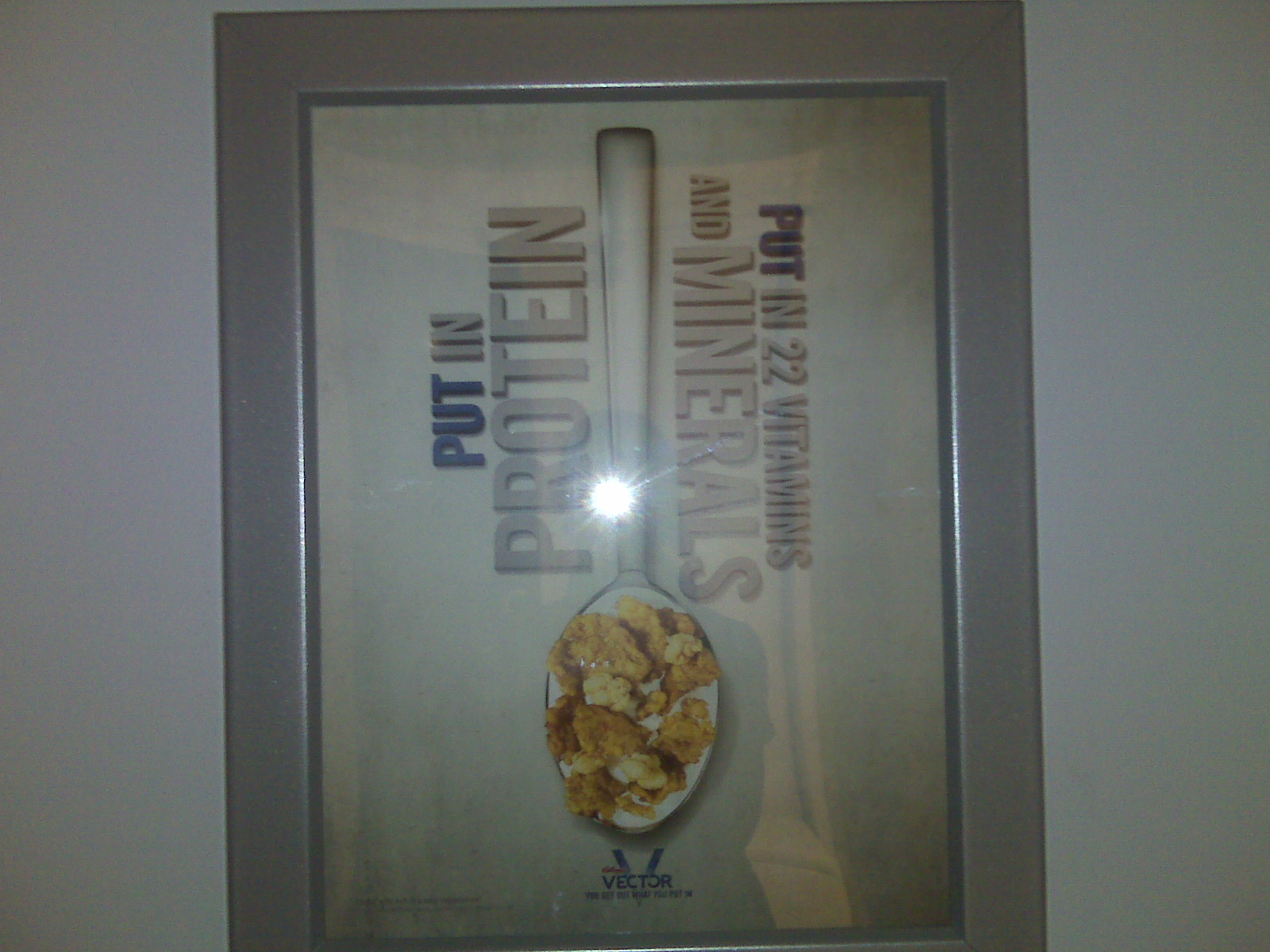
And the best part? The next time I went in the ad had been changed! Now I get to stare at this as I change into my gym strip:
E to the D is making the world a better place – one step at a time!
…
As an addendum to this post, can we all agree on the overall greatness that is Jurassic Park – both the book and film?
This evening my husband and I were waxing eloquent on the impact these two works had on us as young things in the early 90’s, and seriously, I think I’m going to find a used copy of the book so I may relive the memories.
But let’s just get one thing straight – no one is EVER going to survive 10,000 volts. Right? I mean, come on. Dinosaurs from mosquito DNA I can handle, but human BBQ from a T-Rex enclosure? Not. A. Chance.
Also, anybody hear that? It’s a, um… It’s an impact tremor, that’s what it is. I’m fairly alarmed here.
Sometimes you wondered, “What the heck I am I doing here? I don’t have to be here…going through this. And then you liberated a village and these people came out from – I don’t know where. They came out and then you knew why you were there.”
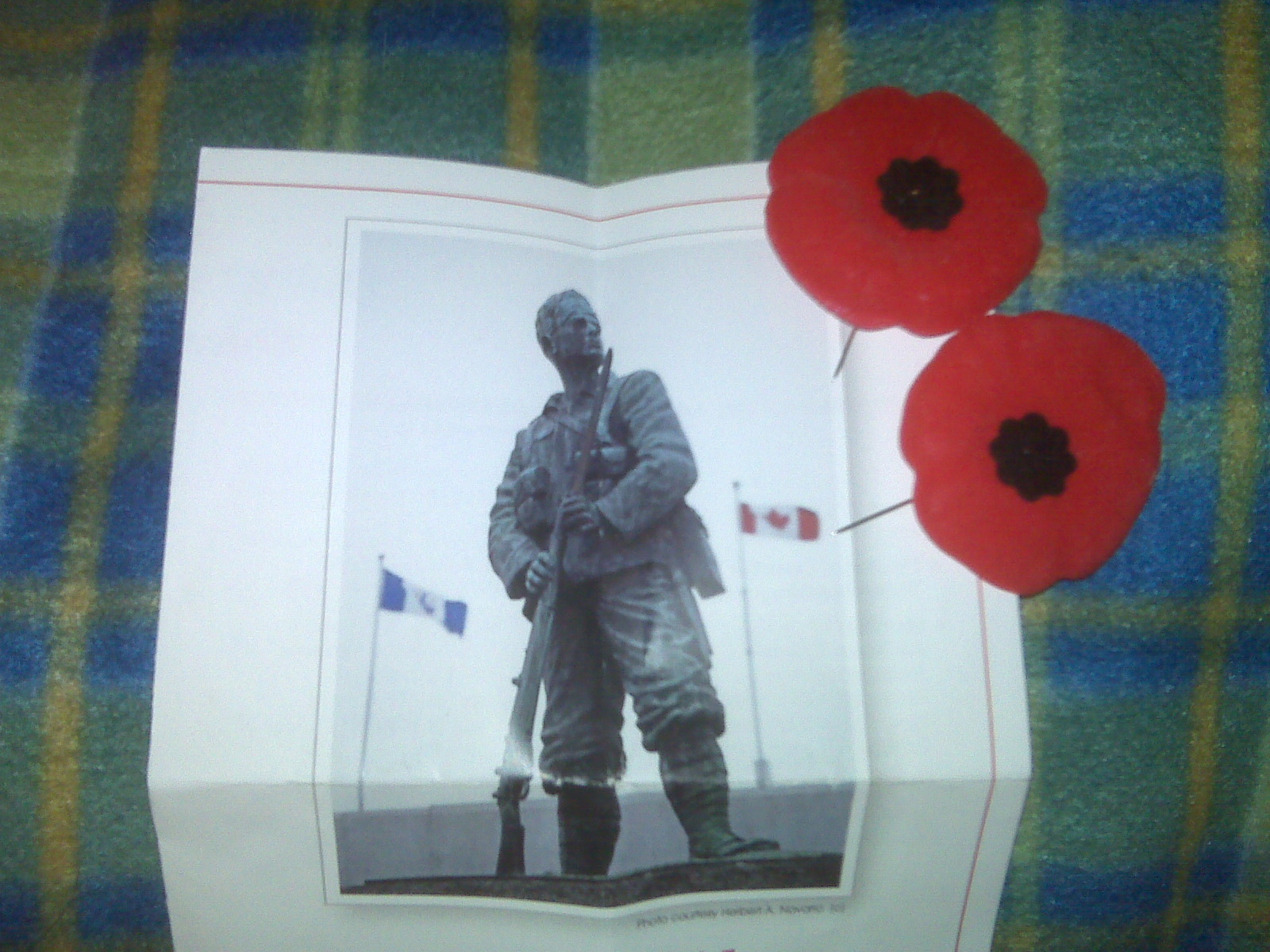
Today I remembered.
“I was scared. I was really, really scared. But you just had to keep moving forward.”
Both my grandfather and my husband’s grandfather served in World War II. M’s grandfather enlisted when he was sixteen, and fought for six years in North Africa as a member of the British Army. My grandfather was eighteen when he joined up with his three best friends, and stormed Juno beach on June 6, 1944.
“You either grew up right then. Or you didn’t grow up at all.”
Today I remembered our grandfathers.
I remembered the men and women who have given their lives fighting so others could live. I remembered the civilians who have died, and who continue to die, in armed conflicts, the world over. I remembered all those who have been persecuted and punished, or who have perished for no reason, save for the fact they were the wrong race, wrong religion, wrong sex. I remembered those who have died because they loved the wrong person. Those who were killed because they had the wrong mental and physical abilities.
“We stand for two minutes. What do the dead stand for?”
I remembered that remembrance should be inclusive and not divisive. I remembered that although the world’s processes and organizations are constructed and legitimized by absolutes, binaries and ideologies, and that we must work to move past these if we are ever to contemplate, let alone achieve, peace.
I remembered that it is these constructs that allow us to strip a person of their humanity, to strip an entire nation of the same.
Complacency may not equal acceptance, let alone action, but can it equal complicity? How quickly are these conceits internalized? Does internalization equate acceptance? And how quickly does this manifest into action, conscious or not?
“The two things you needed to stay alive where your shovel and your blanket. As long as you had those two things, you might live to see the next day.”
Today I remembered that there are those today, who join the military because they believe it is an avenue to help others.
They enlist because they remember, what we remember, on the eleventh day of the eleventh month.
I think people sometimes forget this. I do.
Today I remembered Vimy. Passchendaele. Le Somme. Ypres.
I remembered the war to end all wars.
“We got to live. We got to come home and have families. They didn’t. There were some people who didn’t even make it off of the boat. They were dead when we got there. How many people stop to think about them? How many remember?”
Today we remembered.
But it is easy to forgot.
And continue to forget.
Fyodor Dostoevsky wrote: “Every ant knows the formula of its ant-hill, every bee knows the formula of its beehive. They know it in their own way, not in our way. Only humankind does not know its own formula.”
My mother is currently enrolled in a Russian History course at one of the local Halifax community colleges. She phoned me in a panic the other morning, nervous over the fact that she had signed up to a debate during her next class – she was to take the side that the USSR was the primary cause of the Cold War.
She asked me for my help and instead of yelling, “THAT TOPIC’S A LITTLE TOO SHALLOW EH? WHO IS YOUR PROF? GOOD OL’ JOE MCCARTHY? THIS IS NOT AN INTERNET NEWS SITE COMMENTS BOARD – YOU CAN’T JUST BLAME ONE SIDE!” I readily offered my assistance. Little did I know that I was agreeing to a little more than an ear to bounce ideas off of.
If you’re reading this mom – no more freebies! Do what all the other cool kids are doing: it’s called Wikipedia.
As a postscript, or palate cleanser, to the information I put together for the impending debate, I would like to share with you a memory from my time in St. Petersburg.
…
One morning I walk to the Soviet memorial commemorating the 900 day siege of Leningrad. This proves to be an excellent lesson in how to properly read maps and scale diagrams. It seems as though my ability to master this is minimal. I suck. Truly. The ten mile trek took upwards of three hours and I briefly considered living at the war memorial for the rest of my stay, instead of contemplating the trek back.
Along the way, I passed roughly seventy uniformed and armed police men, who I suppose are told to stand with their backs straight and lips pursed, and to spread out equally four to a block. Having passed the one hour mark and with no memorial in sight, desperation slowly began to set in.
As I approached one of officers to ask if I was going in the right direction, I truly regretted my choice to wear my grey t-shirt spackled with sparkly clouds and rainbows. I figured my looked screamed stupid tourist. Yet when he turned to face me, I lost both my apprehension and vocabulary. There was no way this officer was any older than sixteen! His thin frame was swathed in an ill-fitting uniform, and the way his eyes kept darting back and forth, it made me feel as though I was asking him out.
I pointed to the memorial on my map and asked him in broken Russian, “This place, long or short distance?”
He looked at the map and then looked at me and then looked at the map and before settling on his shoes as his best bet for point of focus. “No, no,” he told me. “Round. Round.”
I wanted to scream. Of course I knew the memorial was round! What I really needed to know was whether or not I’d make it to the place by nightfall. Unfortunately, he seemed to think the conversation was over and so I left, hoping that as long as I stayed the course, I would get there eventually.
And get there I did.
Eventually.
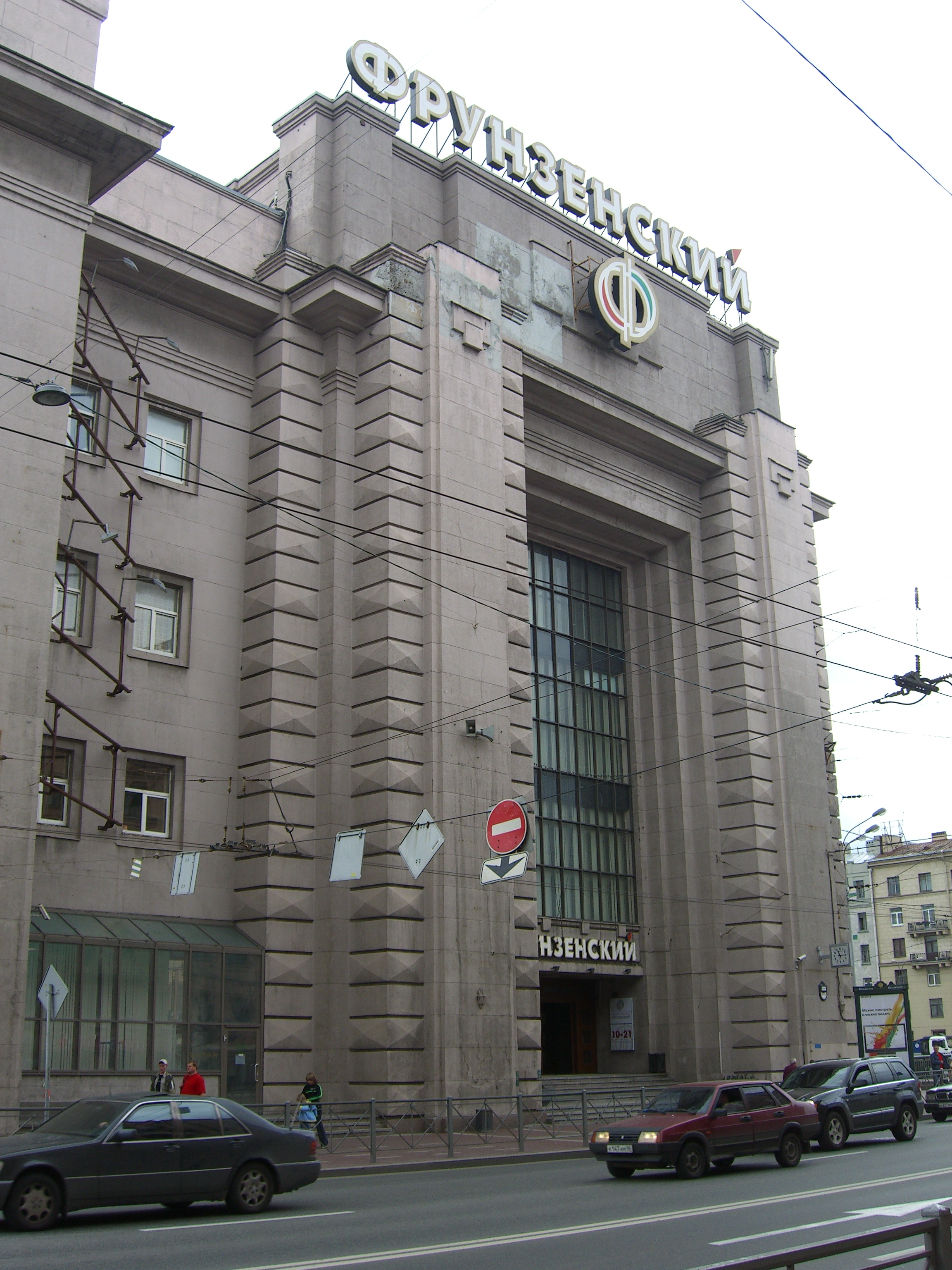
In the block leading up to the memorial, I encountered a monstrous statue of Lenin, surrounded by three beautiful water fountains. They serve as an introduction to one of the city’s oldest government building; its grand, Victorian architecture stood in stark contrast to the cubic glumness that marked the many Soviet buildings I had passed by that day. I watched people eating lunch on its steps, while others held hands, sitting in twos on the manicured grass.
Try as I might to take a photo of the scene, the mangled power lines mashed across the skyline and the non-stop traffic wreck havoc with my shot. The statue of Lenin stands unopposed – daunting in the foreground.
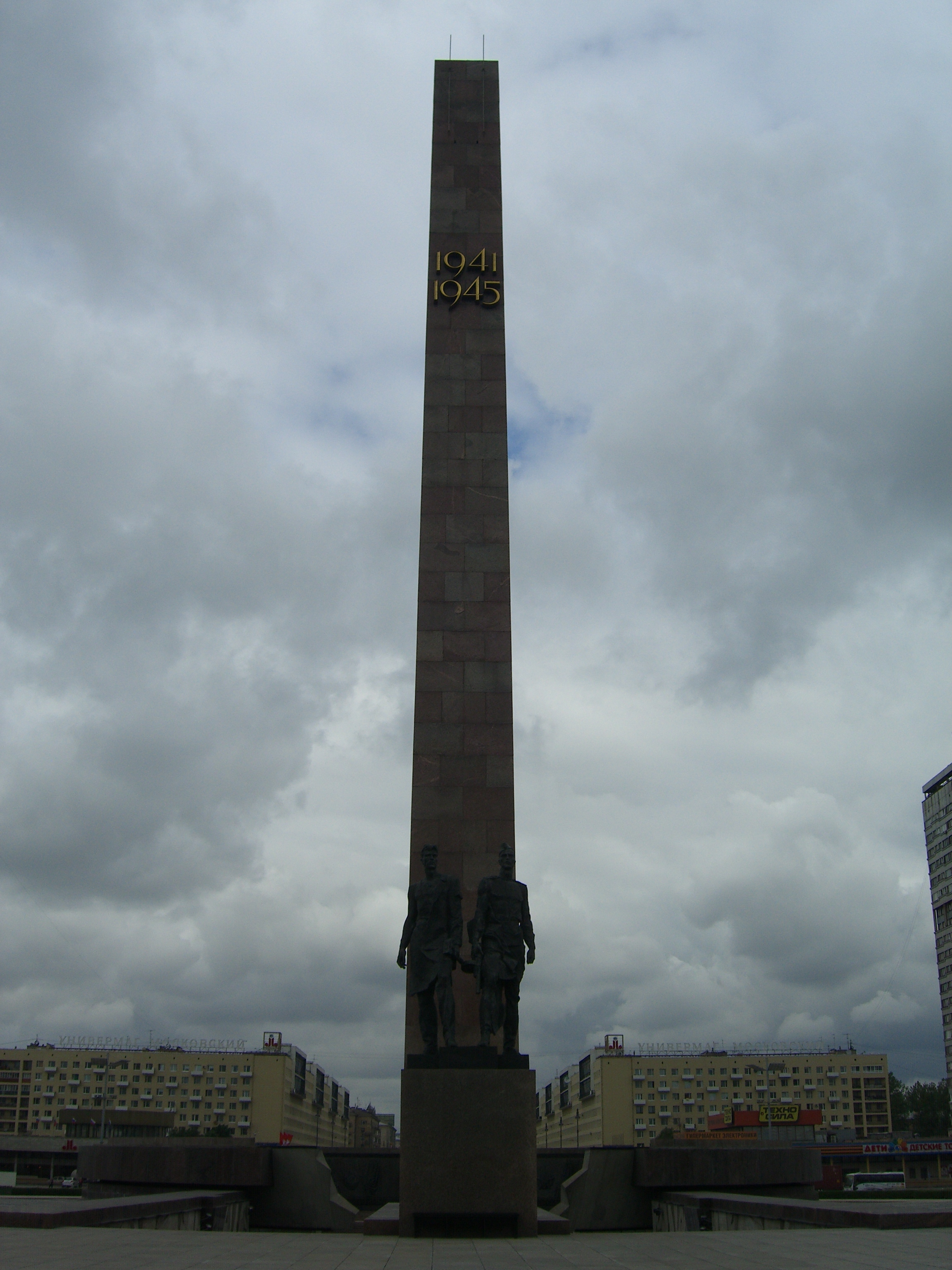
The memorial itself, Ploschad Pobedy, serves as a round-a-bout at the mouth of one of the busiest entrances to the city. It is large. Beyond large. Humungous. My knees knock together as I walk to the center of the circus.
A forty-eight meter high obelisk penetrates the clouds above while giant marble statues of bare breasted women and aged men stand defiant in the face of an unseen enemy.
Their faces scream of a rage and sorrow that I will never know. Their hollow cheeks and sunken eyes speak of winters so harsh and unrelenting, that those who looked healthy stood accused of consuming the dead, because there was never any food to eat. Day, after week, after year they watched their staircases freeze, along with their water supplies and their children in their beds. Tanks, though immobilized, roll on for eternity. Machine guns fire with an endless supply of bullets.
Around these statues, dilapidated apartment buildings crumble before my eyes. A sour faced babushka drags her grandchild into a consignment store, whose window displays are crammed full of mismatched shoes and bar laundry soap. In front of me a family takes photos in front of an ever-lit flame. They all laugh as a little boy pleads with his grandfather to pull him onto his shoulders. I wish so badly that someone, anyone, could be here to witness this with me.
As I walk into the museum, the eerie tick-tock of a metronome punctuates the stale air.
My city guidebook tells me that it is supposed to represent the city’s heartbeat that never stopped, has never stopped despite the challenges it has faced throughout its lifetime. The hallways and rooms are dimly lit by nine hundred lamp-shaped candles; each one serve as a reminder of the nine-hundred day bombardment that this city somehow managed to withstand.
I slowly walk by glass cases filled with German shells, Soviet identification cards, rusted bullets and chipped mess tins. At each end of the room the walls are decorated with a magnificent mosaic. Each was constructed from the thousand of kilograms of broken glass that littered the streets throughout and after the war. I stare at soldiers who cling to outdated guns.
Explosions that rock buildings and sever limbs. Children who wail, bombs that fall, worlds that collapse. Minute after minute ticks by as I stand in front of these works, my breath still. Tears slip down the sides of my face, into the dips of my ears, into the corners of my mouth. My body gives in to an ache that heaves and swells with each beat of the heart.
As I move to trace the mouth of a young soldier the woman behind the desk stops me.




 Rant and Roll