Eyes firmly on the prize

Here’s a weird thing that I did once.

Last November I got eyelash extensions.

The impetus behind this decision?

“The Holiday Season.”

And just to try something different.

The process of getting them done was more bizarre than anything else. Beyond being uncomfortable, it was also weirdly vulnerable. Lying on a bed in some woman’s 400 square foot bachelor apartment, as she slowly separated each of my eyelashes and glued monstrously fake lashes to their roots, I was acutely aware of how little room for error there could be in this procedure, what with her disproportionately sized tweezers so close to my eyeballs.

I was sure that one rogue sneeze would see them forever lodged into the base of my optic nerve.

Halfway through I remember thinking, “THIS ISN’T WORTH IT.” This reaction is, of course, my modus operandi when it comes to all aesthetic services. At some point I always find myself wishing I hadn’t committed to whatever hair I am having removed, or roots I am having having dyed, and had instead bought a big muffin and went for a walk in the sun.

But getting back to eyelashes – as I studied myself in a small hand mirror (passed to me after the glue had hardened on the last lash) I marveled at how many of my natural lashes it seemed I had lost in the process. Eyelash extentionists (and their proponents) claim that eyelash loss during the procedure is a myth, because all they are doing is attaching a longer lash to the ones you already have. However, I am suspiciously sure that I had way more eyelashes walking into that apartment, than I did walking out.

Of course, this didn’t matter in the slightest, because what I did have in their absence were synthetic masterpieces so utterly grand that they not only took over half of my face but gave me powers of flight every time I made the mistake of blinking too hard.

Once I got used to the heaviness of the lashes during my normal day to day, and the utter wretchedness of not being able to scrub my face in the shower, I really did start to enjoy them. Of particular note were the reactions they solicited from both friends and the general populace. People seemed to think they were pretty neat.

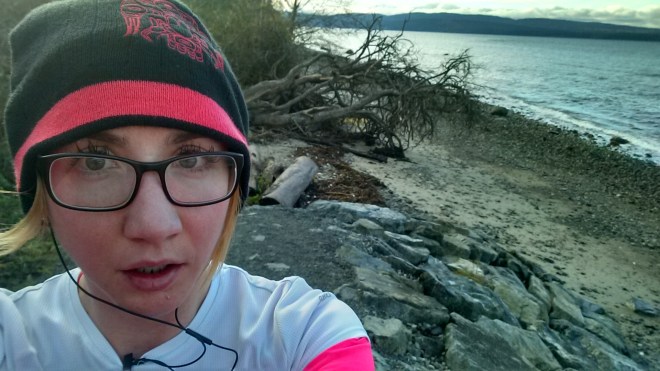
Because the lashes were so big, I wore my glasses almost exclusively, under the belief that my large black rims would tone down some of their impact. Whether this was the case, I have no conclusive evidence either way.
img_20151224_104345151_hdr-1

In the end, the biggest problem with my lashes was how long it took my normal set to grow back once they all fell out. The extentionist had guaranteed that as I shed my prosthetics, my regular lashes would grow in at their normal rate, and the transition back from fake to real would be seamless and unnoticeable.

This was a big old lie. For weeks I was terrified that my vanity-driven decision to try out absurdly giant eyelashes had resulted in permanent, spiky, stumps, where once my lovely, natural lashes had flourished.

I even bought some stupid tube over the internet that advertised itself as an “all-natural, pharmacist approved growth serum“. A small part of me believed that I was fighting fire with fire, sure that I was going to end up both blind and eyelash-less; but I was desperate, and succumbed to the temptation.

I used that tube until the serum ran dry.

And in the end, my eyelashes did grow back – longer and thicker than before. Now, whether this is due to the serum, the fact that I had lost them all, or just luck of the draw – I don’t know.

What I do know was that I enjoyed my one exercise in tempting ocular fate. I won’t be getting extensions again, and have almost completely stopped wearing eye makeup. I figured best to lay low on the windows to my soul, and just let the sun shine through the way it was intended.

Plus now I can just fully commit to my lips.

Because there is no way that I would ever do anything to make them bigger.

And I like lipstick more anyway.

Oh, the Terror!

Some things:

I recently read an article about the many misunderstandings and misconceptions we – the collective, social “we” – have about singlehood. The author, a single woman, wrote about the many (often invisible) financial and emotional costs associated with being partnerless. She also argued against the often proscribed narrative that one needs to “fix” oneself – while single – in order to attract a mate. According to her, the “love yourself in order to love another” thesis is just a fancier way of saying that humans considered “broken” are unworthy of love. And when we say that someone has found love, we’re actually just saying that, per society’s adjudications, that they have been “fixed”.

This seems universally awful and I was struck my two ideas presented in the piece. The first, that as human beings, we have defined our natural, default status as “partnered” and use modifiers like stable, healthy, and loved (including love of self) to build out this concept.

Now, I have spent half of my life in three relationships and have not been single since December of grade eleven. So while I don’t know what it’s like to be thirty and living without a partner, I do know what it’s like to be thirty and living with a sense of brokenness. I know what it’s like to live a life defined by instability, sickness, and self-hatred and know that this had absolutely nothing to do with my relationship status.

Being in a relationship – as long as it is loving and constructive – can certainly help in times of crisis, but it will never prevent horrible or hard things from happening. And someone struggling, or simply living a nuanced life, isn’t any less attractive because of these things. They certainly aren’t “broken.” I know, because I have been, and continue to sometimes be, this person.

If society cannot recognize this, cannot see that life is an endless obstacle race that allows for the greatest of victories and most horrifying defeats, then this is the thing that requires “fixing.” And all those who refused to acknowledge this truth? They are the ones who will have a hell of a time sustaining a relationship – with themselves or otherwise.

The author also wrote about how being single for her, meant living a life defined by a prolonged absence of touch and she explained how long periods of time without contact – intimate or otherwise – can have a profound effect on an individual’s sense of self.

I have been thinking about this a lot since moving to Halifax because I often think about how much I miss touching Marc.

I wish I could feel his body beside mine in the cool silence of an early morning.  I miss holding his hand while walking down the street and the feeling of his fingers running through my hair when we’re driving in the car late at night.

I miss the solid comfort of his hand on the small of my back when guides me out of the way when we’re cooking together in the kitchen.

There are so many ways in which he and I make contact in our regular day to day; I’ve never before realized how important these little touch points are to me.

Some other things:

As previously mentioned, I have been reading a lot about Franklin and the Northwest Passage, especially in the wake of the discovery of the HMS Terror.

And I think I’ve become obsessed with scurvy.

Obsessed in the way that people become fascinated by serial killers, or the crusades, or other infinitely terrible things, and yet, I cannot help myself. The way the Dan Simmons describes this disease in his book is so unbelievably horrifying that it borders on the intoxicating. I cannot think of a more horrible way to die than to slowly and painfully waste away in the sub-arctic temperatures of the Canadian north, coated in my own frozen blood and sweat, my skin puffed and bloated, like putrefied pizza dough, punctuated and pixelated by my hemorrhaging bruises and festering boils.

How utterly, utterly wretched.

Scurvy has become a bit of a joke in our modern parlance. I used to say that in the absence of any fresh fruit in my life, coupled with the amount of penny candy I ate, that I wouldn’t make it to twenty without contracting the disease.

Now that I know that scurvy is so much more than just a few loose teeth, I am loathe to speak in such jest ever again.

Some last things:

I haven’t worn pants in the past six weeks. It’s been so beautiful and hot here in Halifax that my wardrobe has consisted solely of sundresses and skirts. On the odd night that the mercury has dipped below twenty degrees Celsius, I have conceded to nothing more than a pair of patterned leggings.

I have been practicing piano for minimum on hour every day. I am relearning all of my old royal conservatory grade 8 pieces. It really is extraordinary what your fingers and brain can remember, seventeen years out. My goal is to have three pieces memorized by the time that I leave. I also really need to work on my scales, because goodness knows when you’re not working on those every day your finger work grows shoddy indeed.

I am going to move to Shetland. Become a sheep farmer. And be happy.

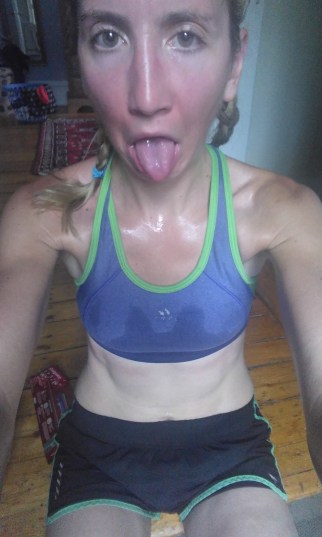
Just sit there and sweat it out

The east coast is humid as hell. The minute you walk outside, you are beset by a sticky, smoky, mug.

The coolness of our house is misleading. I am always sure that I am going to be cold during the first few minutes of my morning run. But that is nothing but a clever ruse on behalf of Nova Scotia Heating and the fact that we live in a very, very old home.

What I wouldn’t give for even a minute of respite from the oppressive exhalation that greets me as I turn to lock the front door. The world feels like an unwanted whisper from a strange man on a strange train.

Suddenly everything is too hot. Too close.

And my discomfort is palpable.

dsc_0014

But it never stops me from running. If anything, it just makes me faster.

I have the mistaken belief that the quicker I run, the more wind resistance I might generate on my flushed and sweat-steamed face.

And while I have yet to see any rewards for my efforts, I keep trying.

Other than three days flattened by a brutal flu, I have run almost every day since coming to Nova Scotia.

I race about the different neighbourhoods of my adopted home. My favourite routes take me to Point Pleasant Park and up to the Citadel. I careen along the South End’s tree-dappled streets, dodging new students moving into their bachelor apartments and soccer moms walking their huskies and duck toller retrievers. I ignore the workers re-paving the road outside of the old military barracks, and sprint past the tourists taking photos of the clock tower.

I have always had a tendency to make up stories about the different people that I encounter on my daily adventures, and since moving to Halifax my internal narrative has delved to new depths.

That man on the corner? Oh, he’s waiting for his man on the inside. But where’s the drop? Where’s the microfilm? Is it up that tree? Or has it been stashed around the corner, behind the fire hydrant? And is that even a real arm brace? Or is it a cleverly disguised weapon?

By the time that I’ve figured out his entire backstory (he’s on his way to meet an ex-CIA operative who he has been trying to get out of the game but who keeps getting dragged back in because of that one shady incident in Dubai twelve years ago), I am half way home.

But not before I espy the woman who just returned from reuniting with her estranged brother whom everyone thought had died in that tragic ocean kayaking accident. It just turned out that he owed money to a man from Havana and had to disappear for a couple of years. She was afraid to tell him that she had sold all of his belongings to put herself through a two-year pottery course, but he was just happy to see her. She told him that she would help him out with the money she makes from her artisan salt shaker business.

Or something to that effect.

The more I make up stories about the people I see, the more it astounds me that anyone can really purport to know anything about anyone.

I am currently reading Dan Simmons’ The Terror, a fictionalized account of Franklin’s doomed expedition in search of the legendary, and always elusive Northwest Passage. It is engrossing and horrifying and I find myself completely sucked in by Simmons’ reimagining of what it was like to be a crew member of the HMS Erebus or Terror.

Talking to Marc the other night, I exclaimed, “My God, Franklin was so dumb. I cannot believe what a loser he was.”

To which Marc very kindly reminded me that I was in fact reading a work of fiction, and we would be hard pressed to really know what anyone was like on that expedition, what with everyone having frozen to death in the barren wasteland of Canada’s Arctic Archipelago.

I quickly acquiesced that he was right.

But I remained rankled. It just seems too true to let it go.

So I’ll just keep making up my own stories.

As I sweat through the mug.

Every day.

Every, every day.

I think they said, the sky’s the limit

Of late, a lot of people ask me how I am.

I mostly tell them that I am okay.

Because I am okay. I am a lot of things, but mostly I am okay.

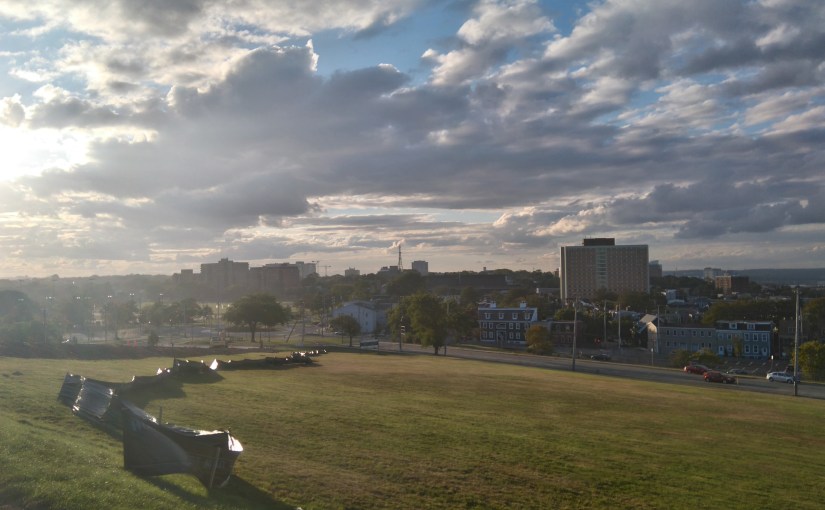
My life in Halifax is pretty simple: I run around the city, I work at my desk. I go for nightly walks up to the Citadel where I take photos of the city’s breathtaking cloudscape.

DSC_0234

The sky is big here. There are no mountains.

When I walk, I listen to Grimes and Of Monsters and Men. I also really like the soundtrack to the movie Drive.

At home, my bedside is littered with biographies of runners. I have reread Hemmingway’s A Moveable Feast twice.

The more time I spend at the Dickson Centre, the more I tune out its tired yellow walls.

I don’t think I could ever be a nurse.

I make vegetarian frittatas with Annapolis Valley vegetables and aged cheddar cheese. I eat a lot of chocolate peanut butter oatcakes.

My mother likes to tell me that oatcakes are healthy.

I don’t think anything with the word ‘cake’ in it can be good for you. But they are delicious.

I ride my bike around the city: to the gym, to the library, to Point Pleasant Park. To the famers market at the Halifax forum.

I sometimes feel lonely. I have to choke back tears. I’m never ready for them, and I always get very angry with myself when I cry.

I chastise my healthy, human self for being silly and immature.

It just makes me feel dumb.

I’ve learn words that I never knew before, like neuropathy and gabapentin.

I think a lot about nerve pain and restless nights. Aching legs. A fatigue that settles like an east coast winter fog.

I do everything I can to sustain summer’s warmth.

When we were in Europe, I borrowed a lot of my mother’s clothing. Living here, I have swallowed her wardrobe whole.

There are some items I can’t make work, no matter how hard I try.

And I try pretty hard.

On Monday, we went to Sears to buy new slippers and a bathmat. Afterwards, I made her try on these pants. They looked really good.

source_photo

She didn’t buy them. They were overpriced.

Ten years ago, my mum was visiting me in Vancouver. I took her shopping on Robson Street. Her favourite store was Mexx, and that afternoon she left with a pair of wide-legged, grey tweed trousers with built-in suspenders. They made her look like a Pulitzer prize reporter, circa 1940. All she needed was a small cap with the word PRESS imprinted on a piece of paper, folded into the brim.

They were perfect.

Whenever I think of my mum at her most epic, I think of her, on that April afternoon, standing outside of her change room.

She looks at me. She squints her eyes.

“Vanessa,” she says. “I really don’t think so.”

To which, I say: “I do mum.”

“I really, really do.”

Getting it Donne

The thing that everyone forgets, when writing long missives about how easy it is to be away from a loved one, is that it’s all complete bollocks.

This became glaringly obvious to me the moment that I found myself standing in the Halifax airport check-in hall, hung over, wearing my mother in-laws old paint spattered sweatpants, with day-old wedding hair, and a stomach churning from dodgy Thai leftovers.

I was crying my absolute eyes out because I felt as though my heart was being wrenched from my chest with a rusty ice claw.

And one would think that, having done this so many times before, that I would never forget how much this hurts, but for some reason, like child birth (I assume) and the act of running a marathon (I know), I just always forget.

Call it the John Donne syndrome. Some stodgy old British genius pens one poem about how gauche it is to show emotion about leaving your spouse for an extended period of time, and suddenly (okay, like 400 years later) we all want to pretend as though spending months away from your life-long kissing partner is easy peasy lemon squeezy.

And yes, I am aware that I am protesting a little too much. It’s been a cool sixteen hours since I bade farewell to Marc at ye good ole’ Standfield International, and my tear ducts are still a little raw. I know that once I get into the groove of things here in the city, the days and weeks and months will literally fly by and before I know it I’ll be back in his arms, cracking jokes about Elizabeth May and watching Danish cop shows.

And!

Speaking of John Donne – I really shouldn’t be so harsh, because I really do love him and many of his works of metaphysical brilliance.

One poem, in particular, will always hold a very special place in my heart: A Valediction: Forbidden Mourning.

I have a very distinct memory of first hearing it in Literature 12, when Mr. Hill, our teacher, and one of my early great loves, read it aloud for the class. He fancied himself a sort of Falstaff/Leonard Cohen figure, and I am pretty sure he knew that most of the class was completely in love with him.

To this day, I don’t know if it was my crush, or the power of the oral word, but everything that he read that year has stuck with me.

At first, I thought Donne seemed pretty uptight, what with so much of his writing purposefully contrasting that of his Elizabethan contemporaries. Donne found most modern prose too smooth, too easy, and it was his aim to experiment with the concept of “dislocation”, peppering his writing with abrupt starts and stops, metaphors and ironies.

(You know, all of the good literary stuff that keeps us lazy readers on our toes.)

Check the below portion of the poem:

So let us melt, and make no noise,

   No tear-floods, nor sigh-tempests move;

‘Twere profanation of our joys

   To tell the laity our love.


Moving of the earth brings harms and fears,

   Men reckon what it did and meant;

But trepidation of the spheres,

   Though greater far, is innocent.


Dull sublunary lovers’ love

   (Whose soul is sense) cannot admit

Absence, because it doth remove

   Those things which elemented it.


But we, by a love so much refined

   That our selves know not what it is,

Inter-assured of the mind,

   Care less, eyes, lips, and hands to miss.


Our two souls therefore, which are one,

   Though I must go, endure not yet

A breach, but an expansion.

   Like gold to airy thinness beat.

I will never, ever tire of the metaphor of the golden thread that ties Donne and his wife Anne together, and my favourite line is: “So let us melt, and make no noise.”

So let us melt and make no noise.

What a perfect image. Such a perfect thought.

It’s one that I think about often as I start a little bit of a new life here in Nova Scotia.

I am melting. And making just a little bit of noise.

I am thinking about healthy ways that I can keep busy. When I spend too much time in my head, I start to think about all of the things that are wrong and bad with me. I think about how much I weigh, or how little I am doing with my life, and why I am not writing more or running faster. I go rope-a-dope with myself as hard as I can until I am left unable to stand.

So last night I wrote out a list of goals that I want to achieve during my time here on the east coast. I found a small note pad of paper and wrote them out on a single sheet, before tucking them away in a chest of drawers.

I figured this would be the closest I could possibly get to burying them in the backyard, like some kind of elementary school time capsule.

(I think about a lot of weird things sometimes. Like, for instance, do you think if someone ran over the person who one week prior ran over their husband that anyone would believe that she didn’t do it on purpose? P.S. This didn’t actually happen and I am not this woman.)

Part of my three-month plan is to go to bed each night having written out a few things that I would like to achieve over the course of the next day. So today saw me signing up for a gym membership and registering myself for two ten kilometer races – one in September and one in October. They are both races put on by MEC and I figure they’re good bets because I’ve loved running their Vancouver series. My cousin David has also started running and he has his own goals of completing a 10k race, so he’ll be joining me on the start line.

It’s always so much nicer to have someone with you on race day.

Another catalyst for these goals is that fact that I don’t have many friends here, and I figure if you don’t have friends, you might as well just get really fit (and hopefully make some friends in the process.)

But mostly I am really trying to melt.

I am trying to be nice to myself.

I am trying to melt.

And to make good noise.