We’ve got a war to fight

My mother is currently enrolled in a Russian History course at one of the local Halifax community colleges.  She phoned me in a panic the other morning, nervous over the fact that she had signed up to a debate during her next class – she was to take the side that the USSR was the primary cause of the Cold War.

She asked me for my help and instead of yelling, “THAT TOPIC’S A LITTLE TOO SHALLOW EH? WHO IS YOUR PROF?  GOOD OL’ JOE MCCARTHY?  THIS IS NOT AN INTERNET NEWS SITE COMMENTS BOARD – YOU CAN’T JUST BLAME ONE SIDE!” I readily offered my assistance.  Little did I know that I was agreeing to a little more than an ear to bounce ideas off of.

If you’re reading this mom – no more freebies!  Do what all the other cool kids are doing: it’s called Wikipedia.

As a postscript, or palate cleanser, to the information I put together for the impending debate, I would like to share with you a memory from my time in St. Petersburg.

One morning I walk to the Soviet memorial commemorating the 900 day siege of Leningrad.  This proves to be an excellent lesson in how to properly read maps and scale diagrams.  It seems as though my ability to master this is minimal.  I suck.  Truly.  The ten mile trek took upwards of three hours and I briefly considered living at the war memorial for the rest of my stay, instead of contemplating the trek back.
Along the way, I passed roughly seventy uniformed and armed police men, who I suppose are told to stand with their backs straight and lips pursed, and to spread out equally four to a block.  Having passed the one hour mark and with no memorial in sight, desperation slowly began to set in.

As I approached one of officers to ask if I was going in the right direction, I truly regretted my choice to wear my grey t-shirt spackled with sparkly clouds and rainbows.  I figured my looked screamed stupid tourist.  Yet when he turned to face me, I lost both my apprehension and vocabulary.  There was no way this officer was any older than sixteen!   His thin frame was swathed in an ill-fitting uniform, and the way his eyes kept darting back and forth, it made me feel as though I was asking him out.

I pointed to the memorial on my map and asked him in broken Russian, “This place, long or short distance?”

He looked at the map and then looked at me and then looked at the map and before settling on his shoes as his best bet for point of focus.  “No, no,” he told me.  “Round.  Round.”

I wanted to scream.  Of course I knew the memorial was round!   What I really needed to know was whether or not I’d make it to the place by nightfall.  Unfortunately, he seemed to think the conversation was over and so I left, hoping that as long as I stayed the course, I would get there eventually.

And get there I did.

Eventually.

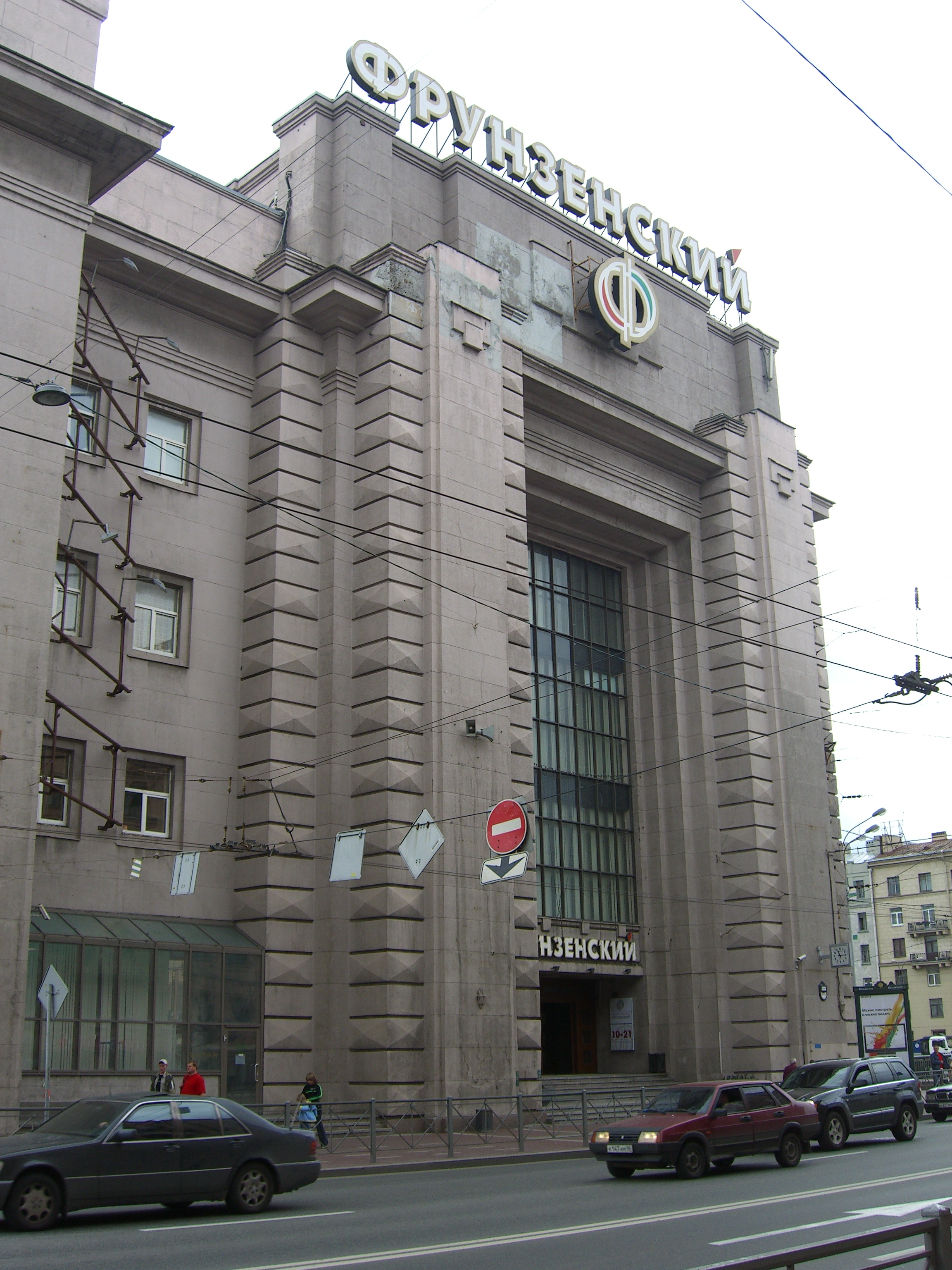
In the block leading up to the memorial, I encountered a monstrous statue of Lenin, surrounded by three beautiful water fountains.  They serve as an introduction to one of the city’s oldest government building; its grand, Victorian architecture stood in stark contrast to the cubic glumness that marked the many Soviet buildings I had passed by that day.  I watched people eating lunch on its steps, while others held hands, sitting in twos on the manicured grass.

Try as I might to take a photo of the scene, the mangled power lines mashed across the skyline and the non-stop traffic wreck havoc with my shot.  The statue of Lenin stands unopposed – daunting in the foreground.

The memorial itself, Ploschad Pobedy, serves as a round-a-bout at the mouth of one of the busiest entrances to the city.  It is large.  Beyond large.  Humungous.   My knees knock together as I walk to the center of the circus.

A forty-eight meter high obelisk penetrates the clouds above while giant marble statues of bare breasted women and aged men stand defiant in the face of an unseen enemy.
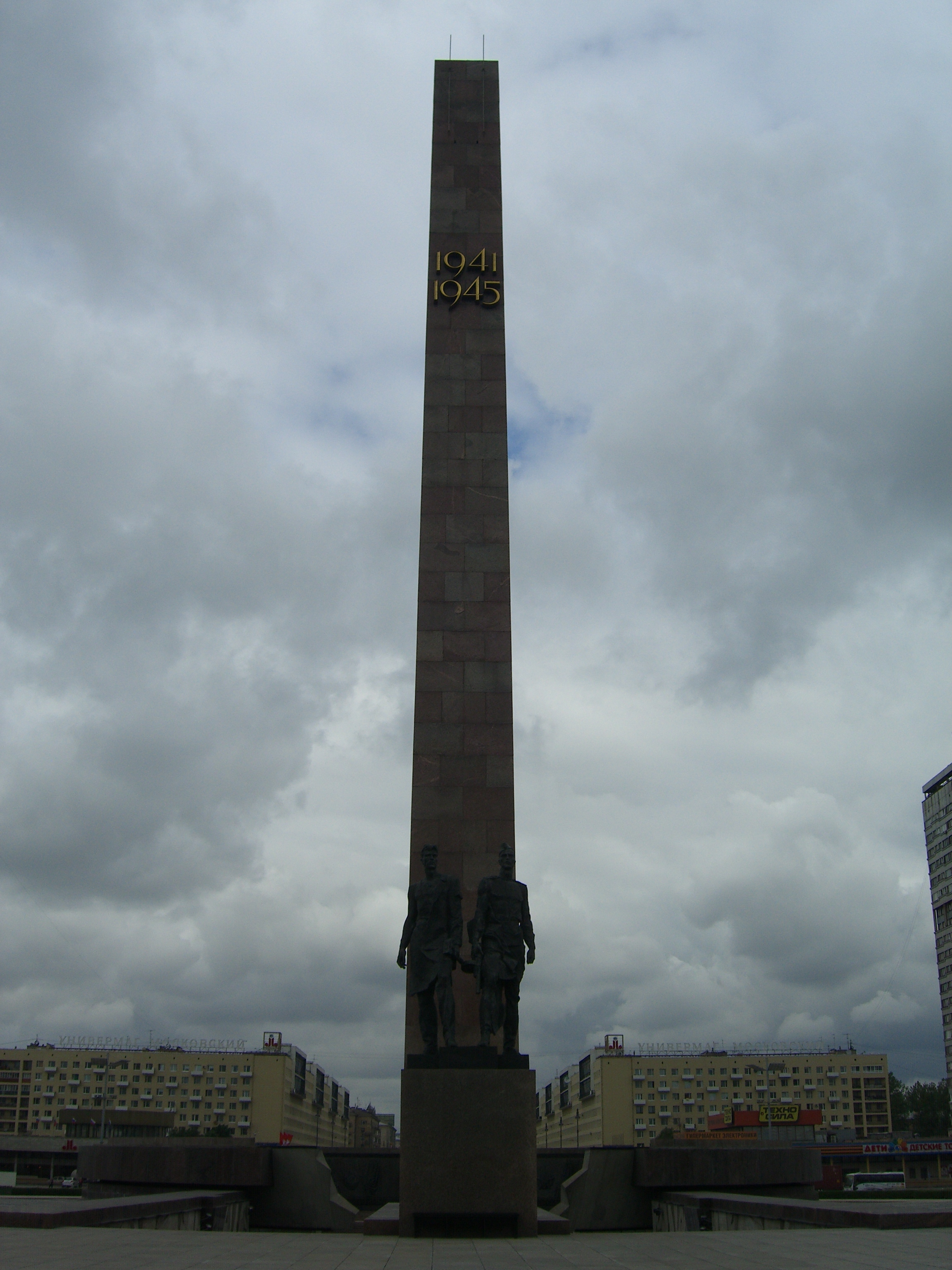
Their faces scream of a rage and sorrow that I will never know.  Their hollow cheeks and sunken eyes speak of winters so harsh and unrelenting, that those who looked healthy stood accused of consuming the dead, because there was never any food to eat.  Day, after week, after year they watched their staircases freeze, along with their water supplies and their children in their beds.  Tanks, though immobilized, roll on for eternity.  Machine guns fire with an endless supply of bullets.

Around these statues, dilapidated apartment buildings crumble before my eyes.  A sour faced babushka drags her grandchild into a consignment store, whose window displays are crammed full of mismatched shoes and bar laundry soap.  In front of me a family takes photos in front of an ever-lit flame.  They all laugh as a little boy pleads with his grandfather to pull him onto his shoulders.  I wish so badly that someone, anyone, could be here to witness this with me.

As I walk into the museum, the eerie tick-tock of a metronome punctuates the stale air.

My city guidebook tells me that it is supposed to represent the city’s heartbeat that never stopped, has never stopped despite the challenges it has faced throughout its lifetime.  The hallways and rooms are dimly lit by nine hundred lamp-shaped candles; each one serve as a reminder of the nine-hundred day bombardment that this city somehow managed to withstand.

I slowly walk by glass cases filled with German shells, Soviet identification cards, rusted bullets and chipped mess tins.  At each end of the room the walls are decorated with a magnificent mosaic.  Each was constructed from the thousand of kilograms of broken glass that littered the streets throughout and after the war.  I stare at soldiers who cling to outdated guns.

Explosions that rock buildings and sever limbs.  Children who wail, bombs that fall, worlds that collapse.  Minute after minute ticks by as I stand in front of these works, my breath still.  Tears slip down the sides of my face, into the dips of my ears, into the corners of my mouth.  My body gives in to an ache that heaves and swells with each beat of the heart.

As I move to trace the mouth of a young soldier the woman behind the desk stops me.

“No touching please.”

We gotta move these refrigerators

I have never understood the whole “I-don’t-watch-TV-therefore-I-am” Cartesian superiority thing – as if watching television somehow negates every book read, every lecture attended, every run gone on or piece of classical music mastered.

(This list has been shortened just in case you’re into the whole brevity thing, but please feel free to populate it with whichever activities you see fit.)

Anti-television aficionados will normally let you in on their secret in one of two ways.  The first usually goes something like this:

Player A (played by yours truly in this scene):  “Hey man, do you watch Breaking Bad [or insert some other amazing television show here]?  I just started watching it this weekend and it’s amazing!”

Player B: [smarmy, self-congratulatory] “No.  I don’t own a TV. Fwuh fwuh fwuuuuuuuh!” [adjusts monocle and top hat]

To which my immediate reaction (as Player A) is: “Shut the front door!  No TV eh? Well, ever heard of a little thing called the internet there Einstein?  Because I’m pretty sure that’s where the majority of the world is getting their television these days! Totes McGotes dude, not owning a TV is one crap excuse for missing out on quality television programming!  [pause]  NEXT!”

The second scenario is a little different:

Player A: “Hey man, have you ever seen The Wire [or insert some other amazing television show here]?  I just finished the series and I think it changed my life!”

Player B squints their eyes, and curls their lips.  Their voice is thick with disdain.

Player B: “No.  [Pause] I don’t watch TV.

Now, my first reaction to this situation is, as Player A, to laugh while giving Player B some serious side-eye.  Then I am overwhelmed by the urge to scream, “OH YEAH?  NO TV EH?  What about movies then?  DO YOU WATCH MOVIES, ARSEHOLE?  Because I’m pretty sure television can be just as beautiful, engaging and life-changing as any film, and I can guarantee you there is as much filth being produced on the big screen as there is on that little box!”

[Pause for dramatic effect and to ensure that I didn’t drop any unplanned double entendres.]

And then I round house kick them in their kidneys.  No of course I don’t.  (I would never do that.)

I box their ears.

(I kid, I kid).

Now, while I’ve never quite had the guts to respond in this fashion, it has taken some mighty yoga breathing to keep this rage-attack at bay.

I mean, what can I say?  Like one Homer J., I’m a rageaholic.  I’m addicted to rageahol.

Because honestly, the whole, “all TV is shit TV” excuse is tired, played-out and completely untrue.  Now, to clarify, is the majority of current television programming awful, mind-numbing crap?  Yes.  Undoubtedly and tragically, yes.   And unfortunately, there seems to be an insatiable thirst for this glut of shows that are, for lack of a more poetic term, utter garbage.  (See: most reality television, anything produced by Chuck Lorre, the current Law and Order series [and all of its spinoffs], anything with “housewives” in its title and of course pretty much everything broadcast on the CBC).  This is truly regrettable, because it is this saturation of mindless, unimaginative, monotonous slime that gives an entire medium a bad rap.

In reality, there are a number of truly great shows on television – and (fingers crossed) until the day we see the premier of “Two and a Half Jersey Shore’s Big Bang the Biggest Loser”, this trend will continue.  Or at least until the zombie apocalypse comes to town,  but by then I’m pretty sure people will have bigger fish to fry than arguing over the merits of television.  One thing though – all those schmucks who don’t watch the Walking Dead are going to bite it hard and fast (or should I say, be bit hard and fast), so let that serve as a warning to you all.  Netflix that stuff, pronto.

This zombie will settle the TV debate once and for all. Or you know, eat your brain.

Great television is transcendent.  It is a dramatic art form at its finest and should be celebrated.  Maintaining a storyline throughout multiple seasons without the writing, directing, acting, cinematography (etc. – the list goes on and ever on) suffering, becoming stale or over the top, or losing its momentum is beyond difficult.  It is damn near impossible.  And when this feat is achieved, it is magic.

This magic is so rarely achieved nowadays within any artistic channel.  And because of this I believe we should be galvanizing our forces in all areas, instead of trying to break down one (or multiple) artistic vehicles for the sake of self-aggrandizement or the propagation of whatever lame notion happens to be au-courant that day or month or year.

This too is tired and overly played out.  And it doesn’t make you cultured, it just makes you uniformed.  It’s like walking into a drugstore, perusing their book selection and them proclaiming all literature trash.  Drivel exists everywhere in all forms.  To write off an entire group because of this fact is uninspired and lazy.

So Player B, don’t tell me that you won’t watch TV and somehow think I will admire you.  And especially don’t tell me you won’t watch TV and then inform me that you’re heading out for a night at the cinema.

Because I will tell you that the comedy you are going to watch probably won’t be funnier than Arrested Development -or that inner-city drama won’t hold a flame to The Wire.  I will tell you to open your mind.

I promise, no one is going to force feed you The Bachelor.  I wouldn’t wish that on my worst enemy.

I will tell you to start with Rome – and do as we Romans do.   And always remember, no one likes a chicken:

Take off those shades please, they’re blinding

Okay kids, it’s time for the Friday Fry-up!

1. All together now:  BLACKFACE IS NEVER OKAY.  Never.  Seriously, are we all aware of this now?  Yes?  Either way, let’s just say it one more time, for those folks sitting way up in the cheap seats – Blackface?  Not okay.  EVER.

As for all of the Raffi Torres apologists out there, listen up: it doesn’t matter that you have black friends.  It doesn’t matter that you love Jay-Z.  It doesn’t matter that you’ve travelled to Africa or read Toni Morrison or that Dwyane Wade once dressed up as a white dude.  All of these excuses amount to jack squat.

And it sure as heck doesn’t matter if any of this applies to Mr. Torres.

Especially when you factor in that 1) he plays for a hockey team based in Arizona, a state home to some of the most hostile immigration laws in the United States, and where racial profiling is backed by both government and law enforcement officials and 2) that the NHL has a brutal history when it comes to the treatment of its minority players (see: Emery, Ray; Simmonds, Wayne; Subban, PK; etc.) so making a racial statement (whether intended or not) that shames, mocks and marginalizes a portion of society only reinforces the deep-rooted racism and overt distrust of the non-Canandian “good ol’ boy” that for many, has come to define the NHL (see: Cherry, Don).

Apologizing for his actions just shows how oblivious people are to their own privilege.  And trying to equate Ray Whitney dressing up as a toy soldier (hawhaw so offensive to GREEN people!!11!) to Torres’ costume reveals not only their ignorance, but also that people (many, many of them) are capable of telling really, really shitty “jokes”.

Well, these “jokes” are about as funny and/or witty as the crap, and totally unrealistic materialization of ten thousand spoons (when all you need knife), is ironic.  In short, IT SHOWS THAT PEOPLE DON’T KNOW WHAT THEY’RE TALKING ABOUT and that as of now, their privileges have been revoked.  Seriously, all of them.

All of their privileges are belong to me.

2. As for you, Mr.  John Crosbie, Mr. “Holy smoke, this swearing-in is stuffier than a Moroccan footstool, it’s a dang good thing that I am a comedy king!!!” – your jokes are also neither witty nor funny.  They too are ignorant, marginalizing and racist – three things that don’t really scream “gut busting laughter.”  So really, your “jokes” are just sentences.  Ignorant, marginalizing, racist sentences.

And I’ll tell ya, “knock knock ignorant, marginalizing, racist sentence” doesn’t have quite the same ring to it as orange you glad I didn’t say banana. 

NEXT!

3. Last on the docket are these creepy, and super white-washed Air Canada ads.  They are the next generation of a campaign that advertised travel between Vancouver and China, using only white models.  I really wish I had some photos of those posters to better illustrate my point.  Every time I looked at one I just wanted to yell out: “Did one single person working on this project ever stop and look at who predominantly flies between Canada and China?”

Either way, for a company that is essentially “Canada’s Airline” it would be nice to see a bit more diversity.  Or else I’ll be stuck screaming, “Did one single person working on this project ever stop and look at who is currently living and flying around Canada?  Is this why the mouth breathers still think blackface and racist jokes are okay?”

HELLO?  Anyone?

Where we lay our scene

Currently, my husband and I are operating at full speed ahead.  It is quite a shock to acknowledge that we are now into November and before we know it, it will be December, then New Years – seriously within a hop, skip and a wink he will be wracked by arthritis and my hair will be tinted blue and stiff with aqua net.  Or is it the other way around?  I can never remember.

I would like to take this opportunity to give credit where credit is due, in so far as the man to whom I have pledged my troth until the end of the world (see: Michelle Bachmann, President) is without a doubt the coolest teacher of all time.

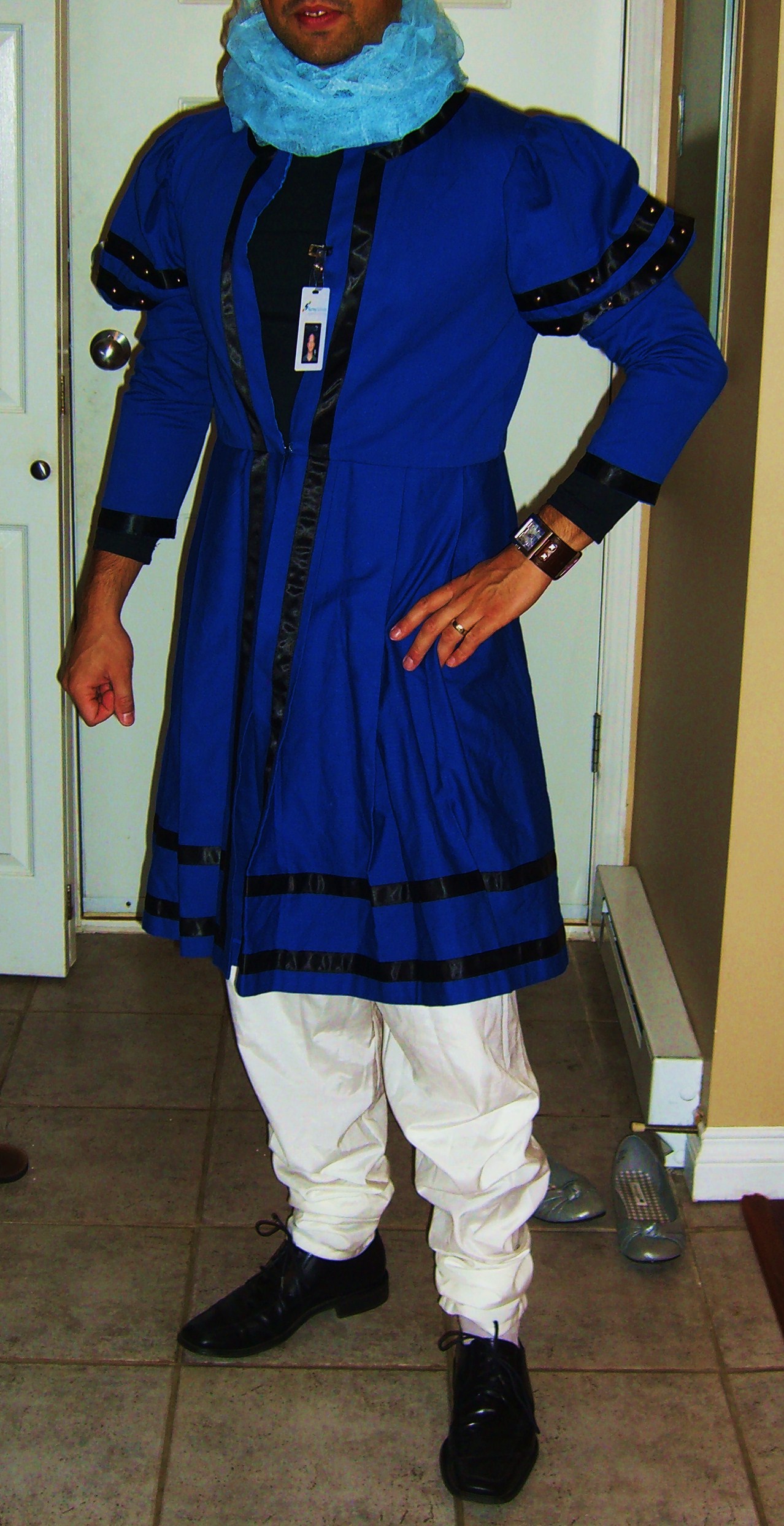
Please see exhibit A: his Halloween costume (which also happened to be his first day teaching Romeo and Juliet).

That ruff was made from a loofah. A loofah!

Exhibit B is a little longer – a snapshot from four years ago – that I hold close.

It is night time and I am writing.  Sitting at the computer, freezing, fingering the frayed edges of my boyfriends old boxer shorts (that I am wearing) I am also listening to my cat, Nymeria, talk to the small birds outside in our cherry tree.  M is lying on the couch reading Ovid, laughing with his eyes, and he speeds through the Amores with zeal unknown to non-classicists or non-nerds.  Despite the chill, there is a slightly sweet smell to the air, and I know this is because spring is slowly breaking out of the frozen walls of ice and fog that winter has trapped her in for far too long.  I think about how we herald spring as a rebirth for the world – for its flora and fauna, for the sleepy bears and their growing young, for the blue jays that rattle our window panes and the daffodils that smile at us as we pass them by.  But I wonder how much of this rhetoric about spring is representative of our time and place, of living life outside an area marred with conflict, violence and fear.  Spring in Poland, during the Russian and German occupations would not signify rebirth, nor a celebration of new life: it would serve as a reminder that despite the change in season, the oppressors and their destructive regimes remained entrenched in everyday life.  I think about what kind of strength of character is required to deal with such a strain.  And how I would do in a similar situation.

I ask M if he has a hero.

“Why?”  He closes his book and pushes his glasses up against his nose.  He is wearing a stained t-shirt (it is the one I wear each time I dye my hair) and shorts whose elastic is so old he has to hold them up as he walks towards me.

Because it is late at night, and we are dressed comfortably.  We are dressed like bums.  We are dressed like those who have nothing, though we have everything.

“Because I am thinking about heroes and I’m wondering if you have one.”

I am half expecting an answer.  The last time I started this discussion, I almost left Red Robin in tears.  This is because I am a bad debater: I have a hard time believing that my opponent’s efforts aren’t masquerading as a personal attack.  The last time we were talking I made it clear that I don’t think that the heroes of classical antiquity are proper heroes: they were too selfish, too obsessed with their own legacy and too drenched in the blood of innocents to have rightfully earned this label.  M, however, understands the reasoning behind Achilles and Odysseus’ actions (and those of their kin), and sees no problem with their association of “hero.”  He also believes that the democracy of Athens is dead and (jokingly) propagates the return of an oligarchy.  Old white men running this old white country: that isn’t so far from our present truth.

As he thinks about the question he thrums his fingers along the cover of his book.

“No, not particularly.  I don‘t think I could say I have a hero.”  He rolls his shoulders and kisses the top of my head, and I can sense him pausing to smell the shampoo scent of my hair.

“What about Romeo Dallaire?” I ask.  I swivel around in my chair and look up into his eyes.  He inhales with a sharpness that sets the hairs on my arms on edge.

“I wouldn’t contest the idea that he is a great man who tried to make the best of an impossible situation.  I admire his strength and courage, but no, he’s not my hero.”

I exhale.

It seems as though tonight, we will be spared a debate (and therefore, my tears.)  M picks me up.  As easily as a rag doll.  He likes to gauge how strong he is getting, by carrying me about our apartment, and measures his gains by how well he can lift me up with one arm.  My hipbone grinds into his shoulder as we pace the length of our living room.

“What about when you were a kid?  Did you have any heroes then?”

Nymeria weaves between M’s legs as he makes his way over to the couch.  She purrs as she rubs up against him, like she knows she is trying to trip us up and loves every minute of it.  The patches of orange and black on her back stand stark against the white of her legs and the slits of moonlight that fall through the blinds.  M lets me down on the cushions, before taking a seat.

“I used to pretend I was one of the X-men.  I had the power to shape matter, and create force fields.  My best friend was Jubilee and we’d hang out at the mall bothering overweight security guards while drinking orange sodas.”

I feel my nose scrunching up as I start to laugh.  I too used to imagine such things when I was younger.  My sister and I would dress up in our highland dancing skirts and wield my father’s blunt tai chi swords because in our minds we were Sailor Venus and Sailor Jupiter battling intergalactic space monsters who wreaked havoc on our homemade Tokyo and its environs.  But although I never missed an episode, I can honestly say I never saw those long-legged cartoon girls as heroes.  They were too weak in times of crisis, always on the verge of annihilation before the masked gentleman would show up and save the day.  As a newly self-discovered feminist, this always horrified me.

I talk to M about my Slavic film class.  I probably talk to him about this class more than any other class I have ever taken.  I am not saying this as a sly way of sucking up to my professor, somewhere, out there, but because it is a truth and my new years resolution for the past five years has been to stop lying so much.

I talk to him about how I am trying to become more aware of the words I use when illustrating a point.  I am becoming aware of the power of speech.  I am becoming aware of the baggage that come with certain terms, or the taste a sentence can leave in your mouth when peppered with contested “truths” or “normalcy’s”.

I tell M about how the Polish Solidarity movement happened the same year as the Moscow Olympic boycott and that I am thinking about the connection between the two events.  And about how Lech Walesa has always been presented to me as a hero, and I believed this because of the enormity of his actions because they took place during a time when enormity was discouraged and suspect and therefore punished.

“I am very proud of you,” he says.  “I am proud to be marrying you.”  I don’t really know what this has to do with Poland or Lech Walesa, but it I feel relief spread over me like fresh jam across crunchy french bread.

“I am trying to find answers,” I whisper to him.

I feel his hand in mind.

“I know.”

Warning: May contain nuts

I speak, of course, of Halloween candy and politics.

Doubt it?  Then check this out – this election ad (albeit American) is one of the most unintentionally hilarious things I have ever seen.  All I can ask is, “who the heck who would actually sign off on this?  And why the cigarette?  Can we please stop speaking in clichés? NO SERIOUSLY, WHO VETTED THIS PROJECT?”

Also, is it just me, or during the last round of federal elections, did campaign ads turn into movie trailers?  I felt as though every time one came on the television I was watching a preview for Canada Wars Episode Six: Return of the Majority.

Anywho, in the spirit of Halloween, I present to you, dear readers, my top six costume ideas for those brave and politically nerdtastic souls who are looking to dress up as Canada’s finest defenders of democracy (and all starring players in the above mentioned film.)

So in no particular order, let us start with:

1. Bev Oda

What you need: Black wig, black sunglasses, black coat, lit cigarette, enough self-confidence to wipe out the entire Cosmo-mag empire and a cutthroat side-eye that that screams:  “no if, ands, or buts – I will cut you.”

2. Justin Trudeau

What you need: Crisp tailored three-piece suit, just-floppy-enough-but-just-curly-enough brown haired wig, gorgeous wife and the weight of the entire Canadian Liberal Party’s fate on your shoulders.  Remember: NO FUR.

3. Rodney MacDonald

What you need: A fiddle, two east-coast music award nominations and a huge loss of confidence.  Bonus: the ability to step-dance.

4. Christy Clark

What you need: A David Schreck approved turtle neck.

5. Stéphane Dion

What you need: A super cute dog named after a Japanese city, top-rimmed glasses, silver fox hair-do, and no I’m not going to say anything mean bout M. Dion because I have a huge soft spot for him because he reminds me of the every-dad, and you ask the every-dad to help you with your science homework or to drive you to your volley ball game.  You do not ask the everydad to run the country.  Why?  Because the every-dad is too busy doing DIY stuff in the basement, solving climate change and wearing Cosby sweaters.  COME ON PEOPLE!

6. Pierre-Luc Dusseault

What you need: A fake ID.

As for me?

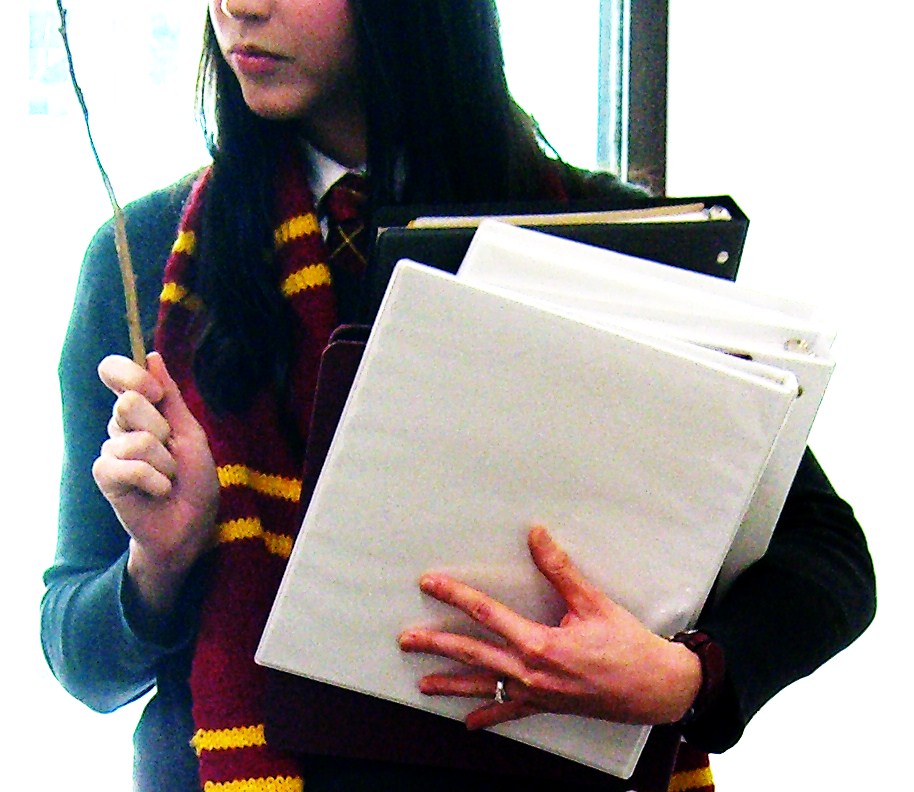
Today I shed my muggleness for a brief foray into the world of wizardry.


ACCIO MINI-CHOCOLATE BARS!